

“OK Albert, give it to me straight about climate change. Is the world getting warmer?”
I think the answer to that question is a definite yes.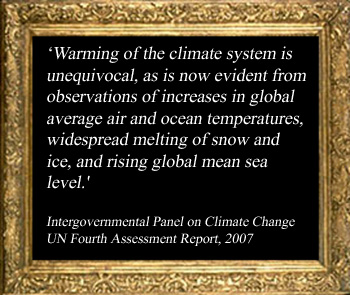 “So why are some people saying global warming is a liberal conspiracy by the makers of wind generators and the like?”
You are confusing something that a lot of other people are confusing too. There are two questions about climate change not just one. The first is the one you have just asked, ‘Is the world getting warmer?’ The second question is what is causing that change. It will be impossible to be absolutely sure about the cause of any temperature change until it is too late. Trying to prove that one thing causes another is surprisingly difficult when it comes to anything as big as the planet. People who seem to be arguing against climate change are usually arguing against the cause of climate change.
“So the world is definitely getting warmer?”
Here is a graph of the world temperature over the last 150 years. The last ten years have been the warmest for a very long time, almost 1oC warmer than back in 1860.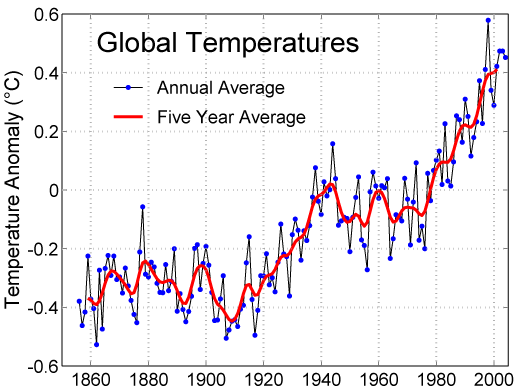
“Only a degree? That’s not much. The temperature can change that much from one day to the next.”
True but that is just the average so in some places it may be hotter and other places cooler. What is also certain is that glaciers and ice at the North Pole are disappearing.
“Does that really matter?”
What happens to the ice that melts?
“It goes into the sea.”
So the sea level rises and low lying cities will be flooded. The sea level has been rising for the last hundred years as the temperature has risen. Ice is also shiny and so ice helps to reflect a lot of the sun’s heat back into space. The worry is that once the ice starts to go, the world will heat up faster and faster as more of the sun’s heat is absorbed rather than reflected.
“So what is all this talk about carbon foot prints and CO2?”
Since humans invented factories and engines we have been pumping huge quantities of CO2 into the atmosphere by burning fossil fuels like coal, oil and gas.
“Why are coal, oil and gas called fossil fuels?”
Oil, coal and gas are all made from fossilized sunlight.
“Huh?”
Millions of years ago carbon dioxide, water and light were converted into sugar and various other molecules, by photosynthesis in plants. When the plants died some of them ended up being buried and over millions of years these prehistoric compost heaps were buried deeper and deeper. Cooked by the heat of the rocks deep in the Earth and squeezed by millions of tons of rock above, the compost was converted in oil or coal and sometimes gas as well. This is why oil and coal are called fossil fuels; they are a type of fossilized compost. When they are burnt to release energy, the carbon dioxide and water that was trapped by photosynthesis millions of years ago is released again. And as we know, carbon dioxide is a greenhouse gas. So even though you could say that most power stations and cars are already solar powered because it took sunshine to make the fossil fuels in the first place, this isn’t any help to the planet. At the moment CO2 makes up only a tiny proportion of the Earth's atmosphere, around three ten thousandth's of it. But all this extra CO2 from cars and factories could double the amount of CO2 in the atmosphere in the next few decades. 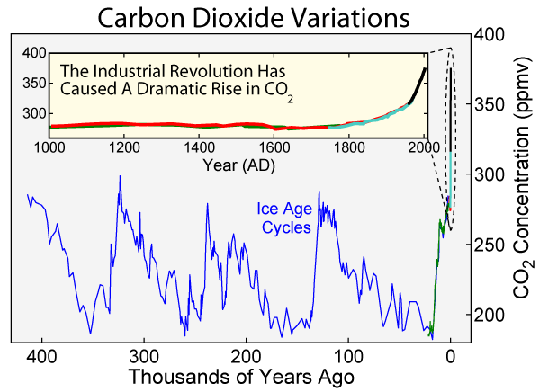
“Won’t some of the plants and trees today end up buried and eventually turn into oil?”
I suppose they will.
“So what is the problem? We burn some fossil fuels now but if more are being made there shouldn’t be any problem should there?”
Good thinking but the fossil fuels being burnt at the moment have taken millions of years to form and will be used up in a few hundred years. So CO2 is being released far faster than it can be turned back into oil and coal. The question is can the Earth cope with millions of years of CO2 being released all in one go?
“Can it?”
Well the only way to be sure is to burn it all and see what happens. We’ve been doing that and the world has been getting warmer and warmer. So if we are worried about CO2 we need to stop burning fossil fuels and find other ways of powering our cars and factories. If we made fuel directly from plants, biofuel, the CO2 released as we drive around would be the same CO2 which was captured from the atmosphere a few months earlier. That way the amount of CO2 wouldn’t increase.
“That’s a good idea isn’t it?”
It is as long as it doesn’t take too much energy to make fuel from plants like corn in the first place. The other problem is that rich countries with enough food might buy up so much corn that poor countries will find it even harder to feed all their people.
“Oh, I’d never thought of that.”
It’s not even a new idea. When the diesel engine was first invented it was designed to use peanut oil and when cars were being made popular for the first time by Henry Ford back in 1903 he designed his Model T Ford to use alcohol as a biofuel.
“Wow, so he knew about climate change back then?”
Not at all, he was no environmental angel. He thought it would be cheaper.
“So why didn’t he build the Model-T Ford to run on alcohol?
Oh, the usual reasons, politics. In 1919 alcohol was banned in North America during the prohibition era and powerful oil interests pushed for gasoline to be used on its own, but imagine how different the world would be if cars had been burning ethanol for 90 years not fossil fuels. The Middle East would be a very different place and world politics would be completely different. Better? Who knows, but certainly they’d be less CO2 in the atmosphere.
“So are humans and all this extra CO2 really responsible for this increase in temperature? Last time we spoke you said that the climate on Earth has had all sort of crises over the last few hundred million years. Ice ages, mini-ice ages and all sorts. If cars were only invented a hundred years ago and the climate has been doing wild things for millions of years it’s not necessarily the fault of humans releasing too much CO2.”
No, but it could be. If there’s any more than a reasonable chance that humans are damaging the planet then they should probably do something about it before it’s too late, don’t you think? 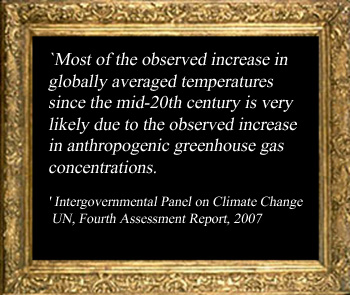 “I was hoping that scientists could give me a more definitive answer. It seems like a simple question to me.”
Well, it’s a question you would have to ask just a single scientist who only has one hand if you want a definite answer.
“Why?”
Because, if you find two scientists they will always disagree about some detail because that is their job. After all, if you accept everything you read you without questioning it you are not a proper scientist.
“OK, but why only a one handed scientist? What’s that got to do with it?”
If a scientist has two hands then he or she can always say, ‘well, on the one hand CO2 is the most likely cause, but on the other hand we can’t completely disprove other theories.’
“Not bad Albert, not exactly funny but not bad for you. Jokes aside why can't scientists just work out what will happen to the world’s climate with a computer so we can stop talking about it and do something about it?"
Nice idea but that assumes that scientists can predict the weather and politicians around the planet can agree what to do about it. Humans seem very bad at both these things. Weathermen have some of the fastest and most expensive computers in the world to help tell them what the weather will be like tomorrow. Initially the calculations took so long that by the time they had got the answer for tomorrow's weather, the weather had already happened. By the time computers got fast enough, the predictions were still not perfect. Then came along a bunch of mathematicians would told them they were wasting their time even trying. This was the birth of Chaos Theory and for a time weathermen, or meteorologists as they call themselves which is a bit odd as they don’t study meteors, were a bit depressed as predicting the weather accurately seemed impossible.
“What is Chaos Theory?”
Chaos theory says that even in systems that seem to have well defined mathematical rules for what should happen next, minute variations can, over time, lead to completely different results. Take a pendulum swinging back and forward, what could be more predictable? But add a little pendulum on the end of the pendulum and it starts to swing very strangely. Add just one more little pendulum on the end and it will swing so chaotically that it is impossible to predict the pattern. Now the climate of the whole Earth is a lot more complicated than a triple pendulum, but it can behave just as unpredictably. We can’t predict whether it’s going to be a good or bad summer next year because of this unpredictability, so predicting the effects of climate change or reducing our production of CO2 is at best and educated guess.
“So Albert, what do you, as a no-handed computer recreation of a famous scientist, say about climate change?”
Imagine you are sitting in your house as a forest fire gets nearer and nearer. What are you going to do?
“What’s that got to do with it?”
Trust me, it will make sense.
“OK. When I got really worried about the flames getting too close I’d eventually leave to go somewhere safer.”
Now imagine the Earth is that house. There is nowhere else for us to go. All we have is this one little planet. Anyway would you really just sit in your house and do nothing until you could see the flames?
“Of course not, I’d phone the fire brigade.”
Would you expect the fire brigade to do anything as the flames continued to spread?
“Of course, I would.”
Imagine they said, ‘We didn’t cause the fire. It was caused by the sun being too hot and drying out the forest too much, so we don’t have to do anything about it.’ What would think then?
“I’d be furious, they should try and do what they could. They could drop water on the flames from helicopters, that would help whatever caused the fires in the first place.”
Exactly. So even if most scientists are wrong and humans aren’t the most important cause of global warming, it doesn’t make sense to do nothing. We know CO2 can act as a greenhouse gas, so reducing human release of CO2 might be the only sensible thing we can do to try and stop the Earth getting hotter and hotter. If there is something you can do which could help isn’t it worth a try? If that something would also avoid polluting the planet, what do we have to loose? At worst, if we are wrong about humans causing global warming and wrong that reducing our CO2 will help, we’ll have a warmer planet that is less polluted.
“Seems simple when you say it like that?”
Everything should be made as simple as possible, but no simpler.
Saturday, October 27, 2007
Climate Change Made Simple
Saturday, October 20, 2007
Seasons, Ice ages and why greenhouse gases are good for the planet.
“So that’s Earth close up?”
That’s it. Pretty isn’t it. Nothing quite like it as far as the eye can see.
“Is it my imagination or is the earth titled over?”
No you are quite right it is leaning over. With maps showing north being straight up people usually think the earth spins upright, but without that tilt life on earth would be very different.
“In what way?”
Well, no seasons. There would just be hot places and cold places. The hot ones would stay hot all year around and the cold ones stay cold.
“Just because the earth is tilted a little?”
All because the Earth is tilted and by more than just a little. The most famous leaning thing on Earth, the leaning tower of Pisa, only leans over by 5.5o. The earth leans over by more than four times as much, 23o. “So could the Earth fall over?”
Well it wobbles at bit, but it’ll never fall over. It’s like a spinning top; as long as it keeps spinning it will stay upright.
“But spinning tops fall over eventually?”
What makes a spinning top fall over is the fact that the bottom is rubbing on the table slowing it a fraction at every turn. The Earth is floating space, not touching anything so there is nothing to slow it down. It’s been spinning for 4 billion years which sort of proves the point. If it wasn’t tilted tree’s wouldn’t need to loose their leaves in winter in colder countries, there’d be no such things as summer holidays and swallows would only bother flying south if the north bored them.
“Hold on, you’ll have to explain that one. How can the earth’s spin cause all that?”
Well, because the Earth is tilted over as it circuits the sun every year then for half the year the top half of the earth is leaning towards the sun and for the other six months the bottom half. When the top half of the Earth is sloping towards the sun, it’s hotter because it’s a bit nearer the sun but more importantly the sun's rays hit the Earth head on. That’s why in summer the sun is higher in the sky. In winter the suns rays hit the earth at an angle and are spread over a bigger area, so it’s much colder. Of course whatever happens in the top half of the world, the northern hemisphere, is opposite to the what happens in the bottom half or southern hemisphere. When it’s winter in Europe, its summer down south in places like Australia. That's why in Australia they celebrate Christmas in shorts on the beach, at least for the time being.
“The time being? Is Australia going to move somewhere else?”
No but the seasons can change because the Earth wobbles as it spins. The bad news for Australia is that over the next 12,882 years the direction of the Earth’s tilt will change. That will make it winter at Christmas in Australia in the year 14,889, but everything should be back to normal by the year 27,772.
“Could that explain global warming?”
The earth’s temperature doesn’t seem to change in synchrony with that particular wobble, so, if the earth is getting hotter as it seems to be, then we have to look at other causes. The problem is that the earth’s temperature is a very fine balance of gaining heat from the sun and loosing to space. All the weather on Earth, even life itself depends on the fact that the Earth is in almost in perfect temperature balance. For all the energy arriving on Earth from the Sun, exactly the same amount has to be lost back into space. If a fraction more arrives than leaves then the Earth heats up. If more is lost than arrives then the Earth starts to freeze over.
“How can a planet loose heat?”
Some of the heat from the sun is reflected by clouds and the ice at the north and south poles. Some of it is sent back into space as infra-red rays. These are the type of invisible photon that carries heat - the same sort of photons that night vision goggles use. By turning infra-red photons into normal visible light, night vision goggles let you see the heat from anybody or anything even in complete darkness. How much infra-red escapes from the Earth depends on the greenhouse effect.
"You told me a while back that it’s the greenhouse effect that keeps Venus so hot. So it must be a bad thing?"
Well it depends. On Venus the greenhouse effect traps so much heat that it is horribly hot but Mars is so cold because there isn’t enough of a greenhouse effect. On Earth the greenhouse effect is there, but not to the same devastating degree as on Venus. You might read about how the carbon dioxide from cars, factories and airplanes is putting the world in danger, but without any greenhouse gases the Earth would be frozen solid and probably lifeless. The most important greenhouse gases for Earth are water in clouds and carbon dioxide gas (or CO2). Clouds and CO2 both absorb infra-red rays leaving the earth and heading off into space. Because the energy is absorbed the earth doesn’t cool down as much. If there was no greenhouse effect on Earth from the water vapour in clouds and CO2 in the atmosphere, the world would be 40oC cooler and most of it would be frozen solid. In all the recent global warming the Earth’s temperature has risen by less than a degree in the last hundred years.
"So what's the problem?"
The problem is that if the greenhouse effect is changed even a little bit that could put the Earth out of energy balance. What happens if you are leaning to ride a bicycle and you loose your balance?
“You fall over.”
Exactly, humanity is like a small child learning to ride but rather than getting the hang of bicycle it has to learn to keep a whole planet in balance. When things on earth get out of balance animals and plants start dying off so it is an important lesson for humanity to learn. The asteroid that hit the Earth 60 million years ago and caused the dinosaurs to die out didn’t kill them by blowing them up, but by changing the temperature balance from all the dust that was blasted into the atmosphere. Dinosaurs couldn’t keep up with the climate change that this dust caused. 245 million years there was an even bigger life wipe-out with 90% of all sea species dying out and that was probably climate related too.
“But that was millions of years ago, things have been pretty stable recently haven’t they?” Well, not really. There have been major freezes or ice ages throughout the last few million years, following a pattern of an ice age every 40,000 years or so. But it’s not got any better recently. It’s only 10,000 years ago since the last proper ice age, with ice covering most of Europe for thousands of years. There was a mini chill just a few hundred years ago. Between the years 1645 and 1715 winters were so cold that it was called the little ice age, the River Thames in London froze so solid Londoners had winter fairs on the ice.
“What causes ice ages?”
There is a pattern in when ice ages happen and a mathematician Milutin Milankovitch from Serbia, in the 1930’s suggested that it was all to do with the wobbles in the Earth’s spin. But ice ages could be caused by lots of other reasons like changes in how brightly the sun shines, sudden shifts in ocean currents or volcano’s. The bottom line is that no-one is quite sure what causes ice ages. The worrying thing about the ice ages is that as scientists are not absolutely sure why they happened in the past, they can’t predict when they might happen in the future.
“Well, if the earth is warming up we could do with another mini-ice age right now.”
I’m not sure the earth can wait 30,000 years until the next one, but let’s talk more about global warming next time.