

 That black hole you were worrying about is only the dot above an ‘i’ on the page of the book we are about to hit.
“So are we going to disappear?”
We haven’t finished our journey yet so I imagine not.
“OK, talk me through this one. Black means no light, therefore if we hit that dot we'll never be seen again. End of story.”
No, luckily for us black doesn’t mean no light at all. The letters on a page will always look black as long as there is a lot less light coming off the black letters than the white part of the page. It’s all about contrast, the difference between the brightest thing you can see and the darkest. This page will look much the same read at night by torchlight or in full sunlight even though sunlight might be a hundred thousand times brighter. There will be more light coming from the black letters in bright sunshine than is coming the white page by torchlight. So exactly the same amount of light can look white or black at different times. Sometimes the same amount of light can look a different colour at the same time.
“How can that make sense?”
Look at this picture. The two squares marked 'A' and 'B' are the same brightness. 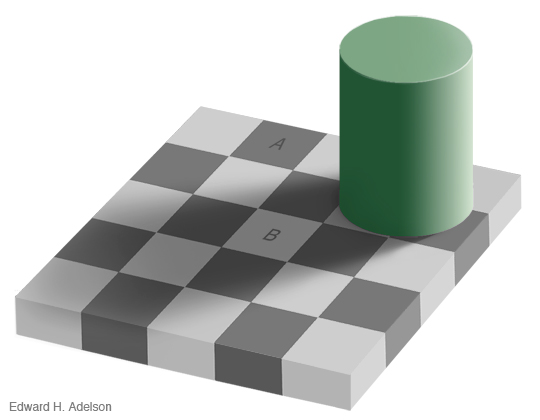
“No they’re not.”
'A' just looks darker because of the way we see contrast. Take a piece of paper and poke two holes so that you can only see the 'A' and 'B' but nothing else of the picture. You will be surprised to see two grey holes of the same colour and brightness.
"Whooaaaaaahhh! What just happened?"
Can I say I told you so?
“You can if you explain what just happened.”
We just bounced of that black dot and lived to tell the tale. The dot is black, so lots of photons were absorbed, but as I said even black things reflect some light and we were some of the lucky ones that made it.
"What happened to the ones that didn't make it?"
Well, they were absorbed by the black ink on that dot. They stopped being photons but they didn’t just vanish. They changed to a different form of energy, mostly heat. In sunlight the letters in an open book will be slightly hotter than the white page because the black ink will absorb more of the sun rays. It’s just the same as sitting in the sun yourself; you get hot because you are absorbing photons. Along with all the others laws that universe follows, there are laws of thermodynamics that explain how energy in the universe behaves. Light is a form of energy and so has to obey first law of thermodynamics. This law says that energy can change from one form to another but can’t disappear or be made.
“How about power stations they make power, isn’t that energy?”
A power station is a perfect example of this first law. Whatever type of power station you think of, they all just change some other form of energy into electricity. It could be wind powered, burning coals which like all the other types of fossil fuel is really stored sunlight from long dead plants, even directly solar powered. But every power station is converting energy not making it.
“OK Albert how abour your E=Mc2? Didn’t you say you can convert matter into energy? So how about nuclear power stations?”
Excellent, so you have been listening. That equation just means that matter is really a special type of energy. So a nuclear power station is a real world proof of Einstein’s equations and the first law of thermodynamics.
"What's going on now? I'm being bent. I've travelled in a straight line for hundreds of years from a distant star and in a few fractions of a second I’ve narrowly escaped dying and been twisted in a very unnatural angle and to top it all we just slowed down."
I think we've just been refracted. We just hit one of the lenses of a pair of glasses.
“Hang on, we can travel through thousands of billions of miles of space at highest speed the universe allows but we can be slowed down by a pair of glasses?”
I’m afraid so, that’s how glasses work. Glass is transparent so light travels through it easily enough, but only at about two thirds of our normal speed. So you see light doesn't always travel at the speed of light. The speed of light, the ‘c’ in E=Mc2, is more like a speed limit than a law.
“So what does refracted mean?”
When light hits something at an angle that it makes it go slower (or faster) it gets bent. That’s refraction.
“Is that the same type of bending of light that black holes or even stars do?”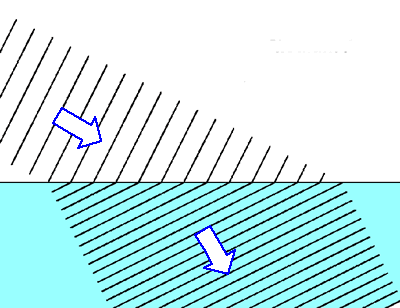
No, refraction is quite different and I’m happy to say a lot easier to explain than relativity. Imagine a car, if you drive straight onto some surface that slowed you down like gravel you would still be going in a straight line, just slower. If you drove onto it at an angle then one front wheel, say the left, would hit it first and that side of the car would slow down. The other front wheel, the one on the right, would still be gripping the road and would keep going at the normal speed for a moment until it hit the slow stuff.
“What happens to the car?”
It gets pulled over to the left until all the wheels are in the slow stuff and then it goes in a straight line in a new direction but at a lower speed. That’s exactly how light gets bent by glasses.
“So how do glasses work?” Lenses in glasses are curved so that they can focus light. Hit a different part of the glass and light is bent a different direction. If you are long sighted your glasses will bend light rays inwards and if you are short sighted your glasses bend light rays outwards.
“How does that help?”
The eye is like a camera and must bring rays of light to a single focus inside the eye. If the focusing isn’t quite right, then glasses can help the eye bring things into proper focus. If you are long sighted then the focussing power of your eyes isn’t strong enough to bring all the rays of light into focus. So glasses for long-sightedness do some of the bending for you. If you are short sighted the eye focuses light too much so by the time it reaches the back of the eye it is blurred. Glasses for short-sightedness bend light away from a focus point to counteract the effect of overly strong eyes. But now it is time to be refracted again, this time by going out the back of the lens and into air again.
"That's much better, almost back to our normal speed 'c'. By the way Albert, why is the speed of light called 'c' ?"
Nowadays people seem to that 'c' comes from the latin word celeritas which means swiftness, but in my day it was because it was a constant. If fact back in 1905, I wrote the equation that everyone now recognises as m = L / V2 because I used V for the speed of light and L for energy, it was a few years later that I re-wrote it as E=Mc2.
Friday, November 23, 2007
Black Holes and Grey Holes - All very strange.
Tuesday, July 10, 2007
To Relativity and Beyond

“So what happened when you first proposed your theory of relativity.”
A deafening silence. I was still working at the patent office when my special relativity paper was published in 1905 and no-one seemed particularly interested at the time.
“You weren’t immediately famous?”
Not at all, I wasn’t even an established scientist at the time. I was a poor patent clerk trying to claim that the greatest mathematical genius of the world Isaac Newton was wrong. It was lucky I wasn’t locked up for being crazy. But a few well known scientists did take an interest. Max Planck and one of my university mathematics teachers, Hermann Minkowski, did believe in my ideas. I am ashamed to say that I skipped a lot of Minkowski’s lectures, but it was he who helped transform a lot of my ideas into solid mathematics in a paper he published in 1908.
“Three years later? Had nothing happened before that?”
Oh there was a little bit of interest. I tried to use my relativity paper to get a university job in 1907 but they wouldn’t accept it. I ended up using a paper that helped prove the existence of atoms and molecules.
“You invented relativity, started quantum mechanics and discovered atoms? When did you find time to do all that?”
All in the same year, 1905.
“Wow. But they knew about atoms before then surely?”
As an idea yes, but a lot of people doubted atoms were real. How can you believe in something that is too small to see?
“How can you believe in things you can’t see?”
By looking very hard at things you can see and using a little imagination. Eighty years earlier botanist called Robert Brown who was looking at grains of pollen in water through a microscope.
“The things that cause hay fever?”
That’s right they are so small they almost float in the air but in water Robert Brown saw that they seem to jump and jiggle around like they are possessed. This is called Brownian motion. Well I looked at the pattern of the jiggling and showed mathematically it made sense if the pollen grains were being constantly bombarded by smaller particles. If you put the pollen in pure distilled water, what else could those smaller invisible things be?
“Water atoms?”
Water molecules, which are made up of three atoms two hydrogen H and one oxygen atom O which is why water is called H2O.
“Neat. So go on, tell me when did you get famous?”
Does that really matter? A lot of people are famous for nothing at all these days. Isn’t if better to be not famous but have achieved something truly important?
“I suppose, but you did both. Isn’t that why you are here explaining all this? So what made you world famous?”
What made the world really take notice was when other people started showing that my crazy ideas seemed to right.
“Wasn’t that your job, to prove your theories?”
I could have but I was a much better thinker than a doer. But before I tell you what happened to make the world really take notice, I have to tell you about general relativity, the full version.
“Oh no, I was enjoying just chatting. Will this be harder than the special relativity you told me about last time?”
It won’t be harder for you, but it was much harder for me.
“Why?”
Because I was trying to bring together my ideas of relativity and create a new theory of gravity all at the same time. The mathematics of general relativity is very tricky and took me more than ten years to get right, but the ideas aren’t too scary. The basis of my idea of gravity should be known to anyone who’s ever been in a lift.
“A lift? How come?”
When a lift moves up suddenly you feel heavier and when it starts to fall you feel lighter. Now what happens if you are in a lift and the cable breaks?
“You fall and die!”
Eventually but while you are falling you will be weightless. Where has gravity gone?
“I don’t understand.”
If you are in free fall you feel weightless, until you land of course. So I realised gravity is just the same as acceleration. Imagine you were floating in empty space without gravity but trapped inside a lift and a passing spaceship grabbed the lift cable and starting accelerating. You wouldn’t be weightless anymore, you could stand on the lift floor. You would feel that up was the direction you were being pulled in.
“OK, but why is that such a big thing?”
It was a huge realisation because it allowed me to create a new theory of gravity. Isaac Newton worked out a mathematical law but it didn’t explain how gravity worked. When I worked out all the details I realised that gravity works because objects, any object bends space. The bigger the object the more space gets bent.
“Here we go again.”
It’s not that hard I promise. Imagine space as not as some solid thing but a stretchy rubbery thing.
“OK.”
When there is an object big enough to create a strong gravitational pull, it bends space just like a heavy metal ball on a trampoline or you on a trampoline. Now if you put a marble on the edge of a completely flat trampoline what would it do?
“Just sit there I suppose.”
Exactly. Now if gently lowered you onto the centre of that trampoline what would happen.
“I’d dent in the middle bit.”
And….
“The marble would roll in to the middle?”
Now you’ve got the idea and that’s how I thought gravity works.
“So does it?”
Well that’s what got me famous. Gravity is supposed to pull together things that have mass, physical things. Light doesn’t have mass, it doesn’t weigh anything so it shouldn’t be affected by gravity, but if gravity bends space then a light beam should get bent with it. I predicted that gravity from the Sun should make light bend by a certain amount.
“How can you show that?”
Well it needs the light beam to be going right past the sun. When the Sun is blocked out by the moon in a total eclipse, the sky goes dark and the stars are visible for a few minutes. This is the only time you can see light from a distant star skim past the edge of the sun. If my theory was right then the stars nearest the Sun should appear to be shifted from their normal position because the gravity of the sun had distorted the bit of space the starlight was coming through. In 1919 an expedition led by an Englishman Arthur Eddington travelled off to Principe Island to study an eclipse the results seemed to agree with my theory. If I've planned things right we might I be able to demonstrate how this really happens.
“How about the ideas about time changing as you speed up? Has anyone shown that really happens?”
That has been tested too but that took a lot longer. It is not easy to find clocks travelling close to the speed of light after all. But fortunately there are natural clocks in the universe. The decay of radioactive atoms, where unstable atoms breakdown usually into smaller ones, is one of them. This is the sort of clock used to work out the age of objects in carbon dating because radioactive decay is like the tick of a clock. The carbon-14 clock ticks very slowly if a bit randomly over thousands of years as it decays into a different atom nitrogen-14, in 5,730 years half of it decays. Carbon-14 in the air is taken up by leafs and gets made into wood in trees and anything else that plants make. By measuring how much of that carbon-14 has decayed scientists can work out how old a piece of wood is, even if it is tens of thousands of years old. Another sort of natural clock is seen in unstable subatomic particles called Mu mesons which last only a millionth of a second or so before breaking down. This is a super fast clock. These particles are made in the top of the Earth's atmosphere by collisions between cosmic rays and atoms in the air.
"What are cosmic rays?"
They are particles like us that come from stars and fly across the galaxy at huge speeds until they collide with something. When they hit the atmosphere of a planet they smash into atoms in the air and produce a shower of particles and atomic remnants. Meson particles are created by these collisions at the edge of the Earth's atmosphere then they shoot onwards to the Earth's surface at 99.5% the speed of light. Even at this speed a millionth of second shouldn’t be long enough to reach the ground before they break up or decay.
"So they never reach the ground?"
That’s the interesting bit, so many mesons reach the ground that they must be surviving roughly ten times longer than they should. At 99.5% of the speed of light how fast do you think time passes?
"At a guess I'd say about ten times slower."
Exactly. Relativity may seem bizarre but it also seems to be true. It’s not just speed that slows down time. In general relativity I discovered that gravity slows down time as well. I was very excited to read that in 1971, sixteen years after I died, J. C. Hafele and Richard E. Keating proved the effects of speed and gravity and time by flying four atomic clocks in opposite directions around the earth and comparing it with a clock on the ground.
“How much did the clocks change by?”
It was only a difference of three hundred billionths of second but the planes weren’t going very fast and it was almost exactly what relativity predicted. To get big effects you need a lot of gravity. Remember we talked about black holes a while back?
“Oh yeah, where gravity is so strong that light can’t escape.”
Well if you saw someone fall into a blackhole from a safe distance they would seem to hover forever at the point of falling in, just before they disappeared from the universe, because time was slowed down so much by the intense gravity.
“What would they see looking out?”
They would be able to see the rest of the universe seeming to speed up. Rather than seeing their lives flash before their eyes, they would see the whole future of the universe unfold in fast forward.
“Wow, that’s freaky….Albert, I hope you don’t mind me saying this, but the Internet is full of nutters who claim you were wrong. I know you’ve explained to me how relativity explains lots of things but is relativity the final answer?”
Isaac Newton’s theories lasted twice as long as mine have so far. Who knows how long my theory will last, perhaps one of those nutters as you call them might be right. A hundred years ago I was just like them, trying to overturn hundred’s of years of tradition and convince people who thought that the answers to all the big questions had already been discovered.
“Have all the big answers been discovered?”
Not at all, not then and not even now. I spent almost forty years of my life trying to work out how quantum mechanics, gravity and relativity could all work together into one great theory of everything and failed. But I died convinced there was a way of tying everything together, God’s blueprint for the universe. So I’m certain a better theory will be discovered one day.
Friday, June 8, 2007
Little green men and Black holes
"Is a star completely blasted into dust in a supernova?"
No there is usually a core left behind and this is where the story gets interesting. Last time you asked a very intelligent question.
“Did I?”
You certainly did, you asked what stops gravity collapsing a star into nothing.
“..and you said it was the charged particles in atoms pushing away from each other like the poles of two magnets.”
Very good, you were listening. Well, that pushing effect which scientists call electron degeneracy is true up to a point.
“Electron degeneracy? What a great name for a rock band.”
Rock band?
“Rock, a new type of music, invented 50 years ago. You definitely need to get your entertainment circuits updated Albert, anyway you were telling me about gravity.”
Ah yes, gravity well if it gets too strong even the forces inside atoms aren’t strong enough and the electrons and protons in atoms get crushed together to end up as neutrons. Neutrons are not charged so can be squeezed together very tightly. A spoonful of pure neutrons would contain billions of tons. These dense neutron remnants are called neutron stars.
“So neutron stars must be tiny?”
They are. A neutron star with twice the mass of the sun might be only 15 miles across.
“So how can scientists see something that small thousands of light years away?”
When they first discovered them they thought they were alien radio stations. I told you earlier about radio telescopes. Well an astronomer Anthony Hewish from Cambridge University became interested in radio waves coming from stars. In 1967 one of his students, Jocelyn Bell, discovered a celestial radio source giving out regular radio pulses every 1.3373011 seconds. It was like radio-lighthouse in space.
“It wasn’t really a radio-lighthouse was it?”
No, but it was initially called LGM-1, short for Little Green Men because it seemed so fast and regular that an alien radio station seemed as likely as anything other explanation. Then they started finding more and more of them all over the galaxy, LGM-2, LGM-3, LGM-4. If you convert the radio signal into sound this is what a pulsar sounds like.
“So the universe does have a ticking clock then, like Newton said.”
No, it just has lots of spinning neutron stars. Like most things in space, the sun, the earth and the rest of the planets, neutron stars spin. And like ice skaters that spin faster as they pull their arms inwards, these solid lumps of matter spin faster and faster as they contract. You end up with a very small, very dense, star spinning around so fast that it can do a complete turn in a couple of seconds or even a fraction of a second. With each spin they give out a flash of radio-waves with every rotation which is why they are now called pulsars.
The Hubble telescope is so good that it has taken pictures that show the spinning of these stars.
“Are you serious?”
Oh yes take a look at this video. These are real pictures of the the supernova seen in the year 1054. The explosion left a cloud of gas and there is a pulsar in the middle of it. You can see the rotation and the ripples coming away from it. That’s the beauty of science, if you get it right everything starts to link together and make sense.
“I’m getting to see why you like science so much Albert.”
If you thought pulsars were interesting I have another surprise for you. Even stranger, and the only thing in the universe that we photons have to fear, is a black hole. They also can be created from exploding stars. If a collapsing star is a bit bigger than a neutron star, then the gravity will crush it to an even small size and create black hole. Like so many things in space, understanding black holes is all about gravity.
"Our friend Newton again?”
I don’t think Isaac would ever have imagined something like a black hole. In fact neither could I. A colleague of mine, Karl Schwarzschild, showed the my theories showed they could exist but I thought it was just a quirk of the equations. He even managed to do these calculations while he was serving in World War I calculating trajectories for artillery shells.
“Black holes and artillery shells?”
Well they both have to do with gravity but the gravity in a black hole is so strong even light can’t escape.
“Which is why they are black.”
Precisely. Here is how to make a black hole. Take the Earth and squeeze it into a ball less than an inch across and run as fast as you can. Most black holes are much bigger than that of course. There is probably a massive black hole in the centre of this galaxy, the milky way, which is about 10 million miles across. As long as the stuff inside is dense enough, gravity will do the rest. For all their mystery, the properties of black holes are still understandable in an apple falling way.
"Hmm, can't quite see how."
It's not as difficult to understand as you might think. You know that the gravitational force of the Earth stops you from throwing an apple into space.
"Of course, that's how Newton got the idea in the first place."
Exactly, if you throw an apple into the sky it falls back down again. Earth is therefore an apple-hole; apples cannot be thrown fast enough to escape the gravity of the Earth. Earth is also a bird-hole; birds cannot fly fast enough to fly into space. It is also an aeroplane-hole. To escape from the Earth you need a space rocket travelling at 25,500 miles an hour, any slower and the rocket will not be able to overcome gravity. Now imagine gravity getting stronger and stronger. The rocket will have to go faster and faster. The fastest thing in the universe is light and I’ll explain in a little bit why nothing can travel faster than us. So a black hole is a photon hole because photons cannot go fast enough to escape from the force of the gravity, in just the same way the Earth is an apple hole, bird hole and aeroplane hole.
“That makes sense.”
A long time before I invented relativity someone had already imagined that black holes could exist.
“Who?”
A Frenchman Pierre Simon de Laplace used this same argument in the year 1798, the year we've just reached, to predict that if a star had enough gravity it would stop light from escaping so become what he called a black star. It seemed such a crazy idea everyone ignored until I started coming up with just as crazy ideas.
"If you can't see black holes, how does anyone know they exist?"
Even though you can't see the holes themselves, you can see the effects of these strange things on neighbouring stars. As matter gets pulled in, it accelerates faster and faster and gives off x-rays in the process, the same sort of x-rays that are used in hospitals to take pictures of bones. These x-rays are a very high energy photon but are invisible and can go straight through your body and out the other side.
"So how do they escape?"
They escape because they are released just before the point of no return as matter is being pulled at huge speeds into the black hole. A special telescope that can detect x-rays from space can tell you where black holes might be. The constellation Cygnus, where we are coming from, contains the first detected object that might be a black hole.
"So what's it called? Vlad the absorber?"
You've been reading too many comics. No it ended up with a very boring name, X-1, because it was the first x-ray source detected in the constellation Cygnus.
“That’s the constellation we came from!
It certainly was, but luckily for us it was 5000 light years in opposite direction to the one we took towards Earth. So aren't you glad you ended up on this journey with me rather than being eaten up by a black hole.
"Oh, yes, but there is a lot space out there ahead of us and it all looks pretty black to me."